
- Demo
BEIT
بيت , a curated Lebanese goods store built around an assistant that actually knows the catalog. It answers questions, reads the reviews for you, suggests what goes with what, understands a sentence instead of a filter, and tracks your order in the same conversation.
- Timeframe
- 2025 — 2026
- Platforms
- Web
- AI
- Pyramid services
- Web development
- Backend & API
- AI integration
- Infrastructure
- Brand identity
- Stage
- In development
- Availability
- Public
Overview
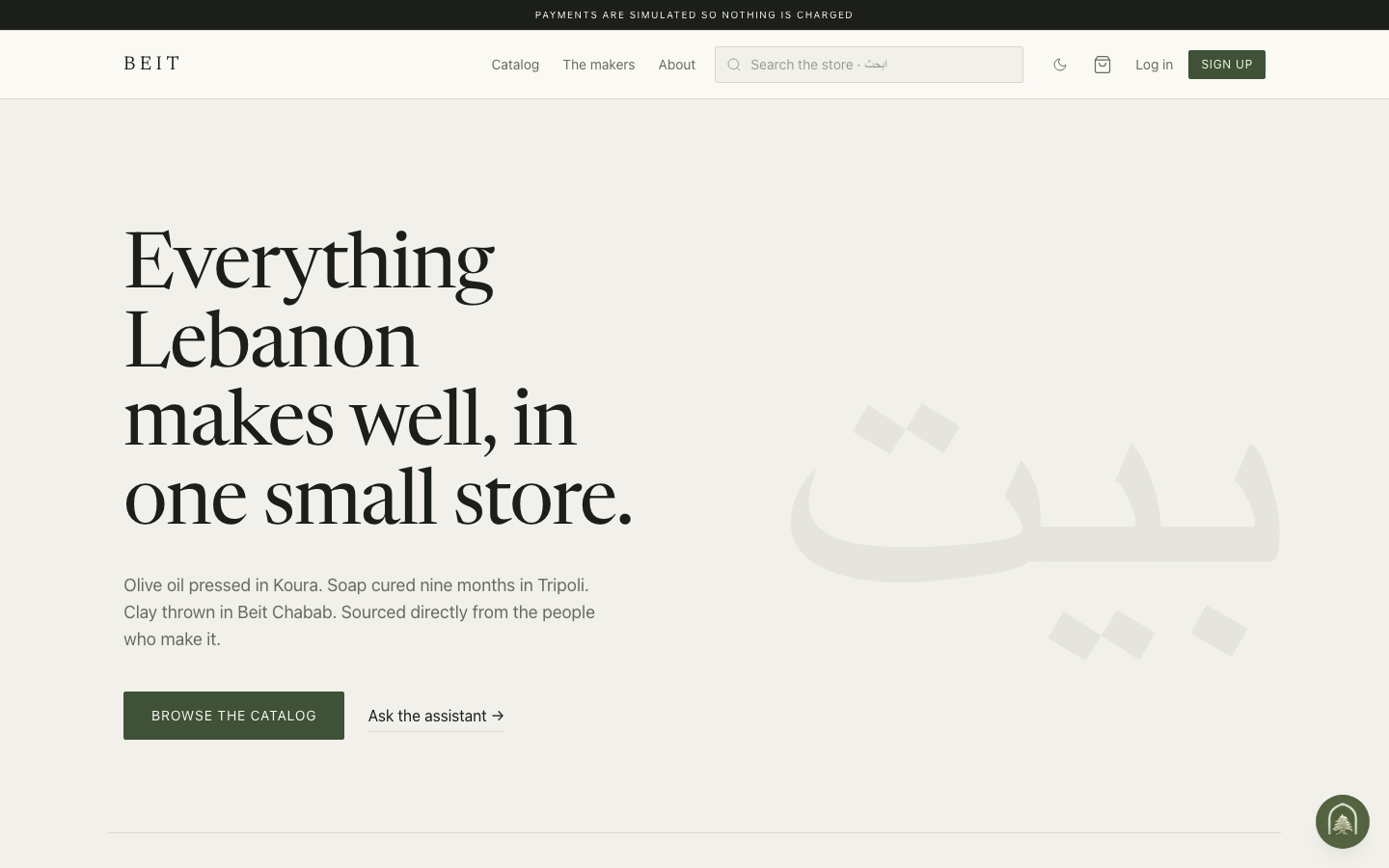
BEIT or بيت, "home", is an online store for handpicked Lebanese goods: olive oil and za'atar, mouneh, coffee and sweets, ceramics, soap, textiles, cedar, glass and copper. Up to Forty-six products across eight categories, each one traceable to where it was made in Koura, Tripoli, Beit Chabab, the Bekaa, Sarafand...etc.
It was built to answer a question that most "AI-powered" storefronts leave open: what does an assistant actually change about shopping, once it can see the real catalog, the current prices, what's in stock, and, for a signed-in customer, their own orders? A chatbot that guesses is worse than no chatbot at all. So the rule from the first day was that the assistant may only say what the store can confirm.
The result is a store where the AI isn't a widget in the corner but part of how the shop works. You can ask a question and get an answer drawn from live stock. You can ask where your order is, and only ever see your own. You can type what you actually want, "something sour for fattoush", "a full set for making Lebanese coffee", "a gift under $30", in English or Arabic, and the store understands the sentence rather than matching keywords. And because the same set of capabilities is exposed to outside AI applications through an open standard, the store can also be browsed and queried by an assistant a customer already uses, without anyone writing custom integration code.
The bilingual search is the piece I'd point to first. The catalog is written entirely in English, and translating it was deliberately out of scope — so an Arabic query has nothing to match on, word for word. Before the semantic work, Arabic questions found the right product about a third of the time; three of the queries in the final review returned nothing whatsoever. After it, every one of the twenty-four benchmark queries used to grade the system returns the correct product first, in both languages, with English quality held exactly where it started. That measurement came from a set of test queries written and judged before any model was chosen, precisely so the score couldn't be massaged after the fact. Five candidate models were compared against it; the winner was picked on Arabic performance, because that was the only thing genuinely at risk.
The store is designed to survive its own AI failing. If the assistant is unavailable, the widget says so plainly and everything else keeps working. If semantic search can't run, the catalog quietly falls back to ordinary search rather than showing an error or, worse, confident nonsense — and the store distinguishes between a genuine fault, which the shopper is told about, and a feature simply being switched off, which isn't their problem. A shopper should never be shown a system's internal state as though it were their mistake.
The look was a deliberate reaction against how AI projects tend to present themselves. Instead of the familiar warm cream, terracotta and soft serif, BEIT uses a limestone neutral with an olive cast, olive as the single accent throughout the interface, near-square corners, and one editorial serif carrying the whole page. Nothing decorative moves: there are four moments of motion in the entire store, and all of them stop for anyone who has asked their device to reduce animation. Every colour, corner, shadow and timing is defined once in a single place, so light and dark are two genuine designs rather than one inverted.
Have something like this in mind?
Tell us what you are building and we will map out how to get it shipped.